
Times When You Need Security Patrol Services in Riverside CA
While it would be nice if you could go about your business without fear of crime taking place,...
Read article →Home / Security Guard Service / Article
Snapshot:
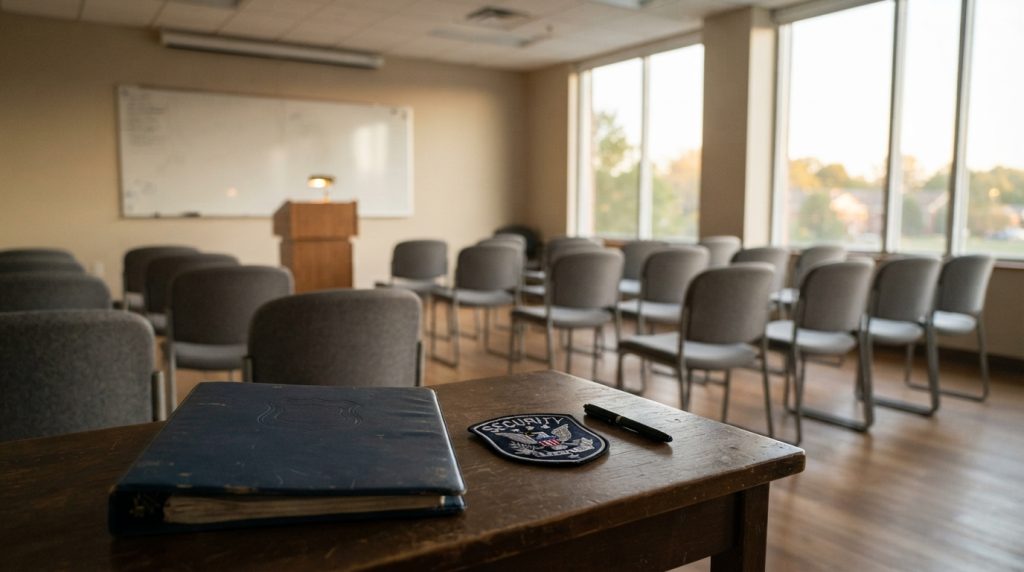
Security guard training in New York refers to the state-mandated coursework that qualifies a person to work as a licensed, registered security guard, covering legal authority, emergency procedures, and on-the-job responsibilities. The requirements are set by the state, not by individual employers, which means the curriculum is consistent regardless of where a guard is hired.
Programs structured around Security Guard Training generally follow the same sequence that New York State requires of every applicant before they can work in the field. Understanding what each course actually contains helps explain why the process takes weeks rather than days, and why employers treat it as a compliance requirement rather than an optional credential.
What the Required Courses Actually Teach
New York State breaks mandatory training into distinct stages, each with its own hour count and content focus.
These stages are not interchangeable. A guard who skips the 16-hour course within the 90-day window falls out of compliance even if the 8-hour pre-assignment certificate is current.
Why the Sequence and Timing Matter
The staged structure exists because New York treats security guard work as a regulated occupation under Article 7-A of the General Business Law. The NYS DCJS training requirements page confirms that the Department of State oversees registration while DCJS approves the schools and instructors delivering each course.
Missing a deadline has real consequences:
|
Course |
Timing Requirement |
Consequence of Missing It |
|
8-Hour Pre-Assignment |
Before applying for registration |
Application cannot be filed |
|
16-Hour On-the-Job |
Within 90 days of employment |
Guard falls out of compliance |
|
8-Hour Annual In-Service |
Every 12 months |
Registration renewal at risk |
|
47-Hour Firearms (armed only) |
Before armed registration |
Cannot work armed posts |
Employers in the region, including those serving Hicksville, NY, generally track these deadlines closely since a lapsed certification can affect a guard’s ability to remain on a post.
How Local Employers Approach Ongoing Training
Beyond the state minimums, security firms often layer additional instruction onto the mandated courses. Based in Westbury, NY, Alante Security Group Inc works with clients and personnel across Hicksville, NY, reflecting how training providers in this part of Long Island typically serve a wider regional footprint rather than a single town. Security Guard Services New York notes that Alante Security Group Inc draws on instructors with backgrounds in municipal law enforcement to teach both armed and unarmed coursework.
Guards working under firms with instructor-led, in-house training often encounter scenario-based practice, report-writing drills, and client-specific protocols that go beyond the minimum exam requirements. This additional layer does not replace the state curriculum but supplements it with practical application tied to the specific environments guards are assigned to, such as corporate offices, residential communities, or event venues.
Frequently Asked Questions
1. Is security guard training the same for armed and unarmed guards?
→ No. Unarmed guards complete the 8-hour pre-assignment, 16-hour on-the-job, and annual in-service courses, while armed guards must also complete the 47-hour firearms course and hold a valid pistol license.
2. How long does it take to complete the initial training requirements?
→ The 8-hour pre-assignment course can be completed before applying for registration, but the 16-hour on-the-job course has a 90-day window tied to the start of employment, so total completion time depends on hiring timelines.
3. Does annual training expire if a guard changes employers?
→ The 8-hour annual in-service requirement is tied to the guard’s registration period, not to a specific employer, so it continues regardless of where the guard works.
4. Are these training requirements the same throughout New York State?
→ Yes. The courses and hour requirements are set at the state level by DCJS and the Department of State, so the curriculum does not vary by city or county within New York.
Looking Up Local Training Details
Security guard training requirements in New York follow a fixed state structure, but scheduling, instructor availability, and course formats can vary by provider. For location and contact details, View Alante Security Group Inc on Google Business Profile for its Westbury, NY location.
Keep reading
While it would be nice if you could go about your business without fear of crime taking place,...
Read article →
Today’s modern security guard is a far cry from the stereotypical image of the aging “rent-a-cop” with the...
Read article →
Safeguarding homes in bustling urban environments requires more than just locks and alarms. In a city as dynamic...
Read article →