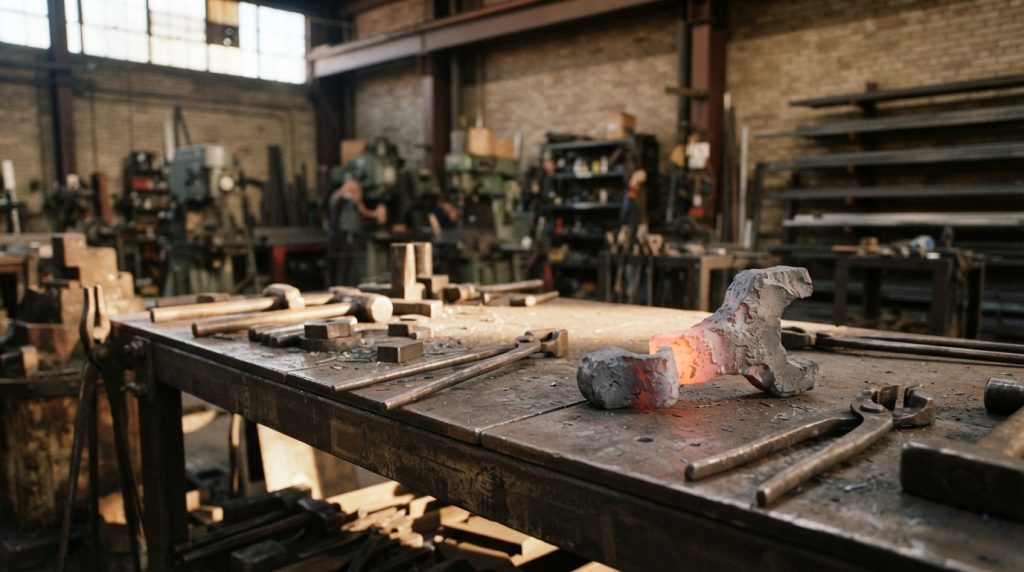
What a Forge Company Does and Why It Matters in Modern Manufacturing
Short version: • A forge company shapes heated or room-temperature metal under high pressure into strong, precisely dimensioned...
Read article →Home / Manufacturer / Article

Plastic components are often expected to meet tight dimensional requirements while staying affordable and consistent from one production run to the next. The right extrusion process can support those goals by turning raw material into continuous profiles with dependable shapes and predictable performance. When researching how to improve production efficiency, buyers may search online for a Plastic Extrusion Manufacturer that can help reduce waste as well as manufacturing costs.
Extrusion is a continuous process, so small improvements can add up across long production runs. Better material use, fewer rejected parts, and less production downtime can lower the cost per finished piece. Those results begin with thoughtful product design and continue through material selection, tooling, process setup, and ongoing quality control.
A profile designed around its intended use can reduce waste before production begins. Consistent wall thickness, practical tolerances, and a cross-section that avoids unnecessary complexity can make the part easier to extrude. This may also reduce the amount of material required without sacrificing strength or function.
Early collaboration between the product team and extrusion specialists helps identify potential issues before they become costly. For example, a design with sharp transitions or uneven sections may be more difficult to cool uniformly. Refining the geometry can improve dimensional stability, reduce defects, and simplify downstream cutting or assembly. Sharing performance requirements, installation details, and expected production volumes helps guide these decisions.
Material yield—the share of purchased material that becomes usable product—is a major factor in production cost. Process adjustments can help increase that share. Operators monitor variables such as temperature, screw speed, line speed, and cooling conditions to keep the melt and emerging profile stable. When these settings are matched to the resin and product design, the process is less likely to produce off-spec material.
Consistent setup also limits scrap during startup and changeovers. Documented production settings give teams a reliable baseline when a job runs again, rather than requiring repeated trial and error. In-process checks can catch dimensional drift early, before a large quantity of material is affected. Measurements should focus on the features that matter most to fit and function, such as wall thickness, overall dimensions, and profile shape.
Quality checks are most useful when they connect directly to corrective action. If readings begin to move toward an acceptable limit, operators can adjust the process before parts fail inspection. This proactive approach helps avoid both wasted resin and the extra labor involved in sorting, reworking, or replacing defective product.
The lowest-priced resin is not always the least expensive choice overall. A material must suit the part’s exposure, strength needs, flexibility, temperature range, and service life. Selecting a grade that is unnecessarily demanding can increase costs, while choosing one that falls short may lead to failures, returns, or premature replacement.
A material review can consider whether recycled content or regrind is appropriate for the application. In some products, controlled reuse of clean process scrap can reduce disposal and virgin-material purchases. However, recycled content must be evaluated carefully: consistency, appearance, mechanical properties, and customer specifications all matter. A qualified production team can help determine what is practical and how to validate it without compromising part performance.
Waste reduction extends beyond resin. A stable extrusion process can reduce labor spent on inspection, sorting, and rework. Reliable output may also make packaging, storage, and delivery planning more predictable. If a profile can be cut to length or prepared to simplify assembly, the customer’s own handling time may decrease as well.
Total cost should therefore include more than the price per pound or per piece. Buyers can assess scrap rates, setup time, quality consistency, lead times, and the work required after extrusion. A slightly higher material or tooling investment may pay off if it improves yield and reduces recurring production problems. Comparing suppliers using these broader measures gives purchasing teams a clearer view of long-term value.
Before approving a project, request a review of the part drawing, critical tolerances, material requirements, and expected volume. Ask how the process will be monitored, how quality records are maintained, and what steps are taken to manage startup scrap. It is also useful to discuss how design changes, material substitutions, or demand increases could affect cost and lead time.
A clear plan makes improvement measurable. Establish baseline figures for scrap, yield, and defect rates, then review them over time. When production data is shared and evaluated regularly, teams can identify patterns, prioritize adjustments, and confirm whether changes are delivering real savings. This ongoing approach helps protect quality while making resource use more efficient.
With careful material selection, process control, and design collaboration, manufacturers can lower scrap without compromising performance. Crafted Plastics Inc offers a reliable regional partner for evaluating extrusion requirements and building a more efficient, cost-conscious production plan for long-term manufacturing success.
Keep reading
Short version: • A forge company shapes heated or room-temperature metal under high pressure into strong, precisely dimensioned...
Read article →
Road construction projects are an essential part of maintaining and improving infrastructure across the United States. However, these...
Read article →
Efficient material handling is a cornerstone of productivity on any job site. Construction crews, landscapers, and contractors all...
Read article →