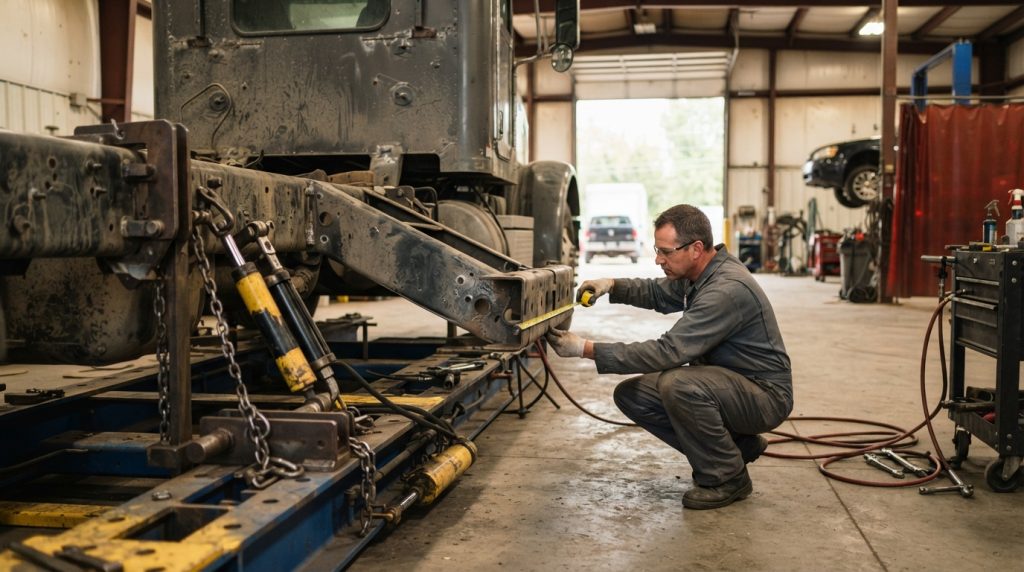
Frame straightening realigns a bent or twisted truck chassis to manufacturer specifications using hydraulic pressure and measuring equipment.
Federal rules prohibit a cracked, loose, sagging, or broken commercial vehicle frame, making timely correction a safety and compliance issue.
Fleet and commercial truck owners around Madison, WI rely on frame correction to restore handling, alignment, and structural integrity after a collision or heavy-impact event.
A bent or twisted truck frame affects steering, braking, and tire wear, and Truck Frame Straightening is the structural repair process that uses hydraulic equipment and precision measurement to return the chassis to factory specifications.
Heavy trucks, trailers, and oversized vehicles carry enormous loads across long distances, and that stress adds up. A collision, a hard pothole impact, or years of cumulative road stress can shift the frame rails just enough to throw off suspension geometry and wheel tracking. Drivers in Madison, WI who notice a truck pulling to one side, wandering at highway speed, or wearing tires unevenly are often looking at frame-related symptoms rather than a simple alignment problem.
Why Frame Condition Is a Safety and Compliance Issue
The frame is the structural backbone of a body-on-frame truck, carrying the cab, box, and drivetrain while absorbing impact forces during a collision. Federal regulation treats frame condition as a hard pass/fail standard for commercial vehicles.
Under 49 CFR 393.201, the frame or chassis of each commercial motor vehicle must not be cracked, loose, sagging, or broken.
Parts and accessories must not be welded to the frame or chassis of a commercial vehicle except per vehicle manufacturer recommendations.
Frame rail flanges between axles are also restricted from being altered outside manufacturer specification, which limits how repairs can be performed.
These standards matter because a frame violation found at a roadside inspection can take a commercial vehicle out of service immediately, unlike many other defects that allow continued operation to a repair facility.
Recognizing the Signs of a Bent or Damaged Frame
Frame damage is not always visually obvious, especially on a heavy truck where the chassis sits below the body and cargo area. Several behavioral and visual clues typically point to a structural issue rather than routine wear:
The truck pulls to one side or will not hold a straight line, sometimes described as wandering or poor tracking.
Uneven or accelerated tire wear that persists even after a standard alignment.
Visible bowing, twisting, or rippling in the frame rails or crossmembers.
Stretching, tearing, or deformation at body and suspension mount points.
A steering wheel that sits off-center or requires constant correction to track straight.
Because frame damage alters the suspension geometry, causing a wheel alignment issue that cannot be corrected through a standard alignment service, repeated alignment attempts that fail to hold are often a strong indicator that the frame itself needs attention.
How the Straightening Process Works
Frame correction follows a defined sequence rather than guesswork, since the margin for error on a structural repair is small. The general process includes:
Visual inspection paired with computerized diagnostics to locate the damage.
Measurement against factory specifications using a frame machine or alignment rack.
Application of controlled hydraulic pressure to bring the frame back into spec.
Reinspection and testing to confirm the correction meets structural and safety tolerances.
Not every damaged frame is a candidate for straightening. If the damage is extensive or the frame is cracked in critical load-bearing areas, replacement may be safer and more cost-effective. In many other cases, though, straightening restores function at a lower cost than a full frame swap.
Repair or Replace: A Quick Comparison
Factor
Frame Straightening
Frame Replacement
Typical cost
Lower, targeted repair
Higher, full component swap
Best suited for
Bent rails, moderate misalignment
Cracked load-bearing sections
Repair time
Shorter in most cases
Longer due to part sourcing and labor
Long-term outcome
Restores factory spec when damage is within tolerance
Eliminates compromised material entirely
A qualified inspection is the only reliable way to determine which path applies to a specific truck, since damage severity varies widely by impact type and location on the frame.
Frequently Asked Questions
How do I know if my truck needs frame straightening instead of a standard alignment? Persistent pulling, wandering, or uneven tire wear that returns after a fresh alignment usually signals a frame problem rather than a simple suspension adjustment.
Is a straightened truck frame as strong as the original? When hydraulic correction is performed to manufacturer specifications and verified with measuring equipment, the repaired section is designed to meet the same structural tolerances as the factory frame.
Can a cracked frame always be repaired by straightening alone? No. Cracks in load-bearing rails or crossmembers often require replacement rather than straightening, since welded repairs on frame rails are restricted to manufacturer-approved procedures.
Does frame damage affect commercial vehicle inspections? Yes. A cracked, loose, sagging, or broken frame is a defined violation under federal commercial vehicle standards and can result in an out-of-service order until repaired.
Service Area and Contact Information
Based in Deerfield, WI, Truckstar Collision Center, Inc serves truck and commercial vehicle owners across Madison, WI, with structural and collision repair work handled from its Deerfield facility.
Facility details and published service information for View Site are available for drivers researching commercial truck repair options in the region.