Popular Medical Aesthetic Treatments and Their Benefits
Residents searching for a medical aesthetics spa in Creekside are usually looking for one thing: a provider that...
Read article →Home / Medical Spa / Article
Briefly:
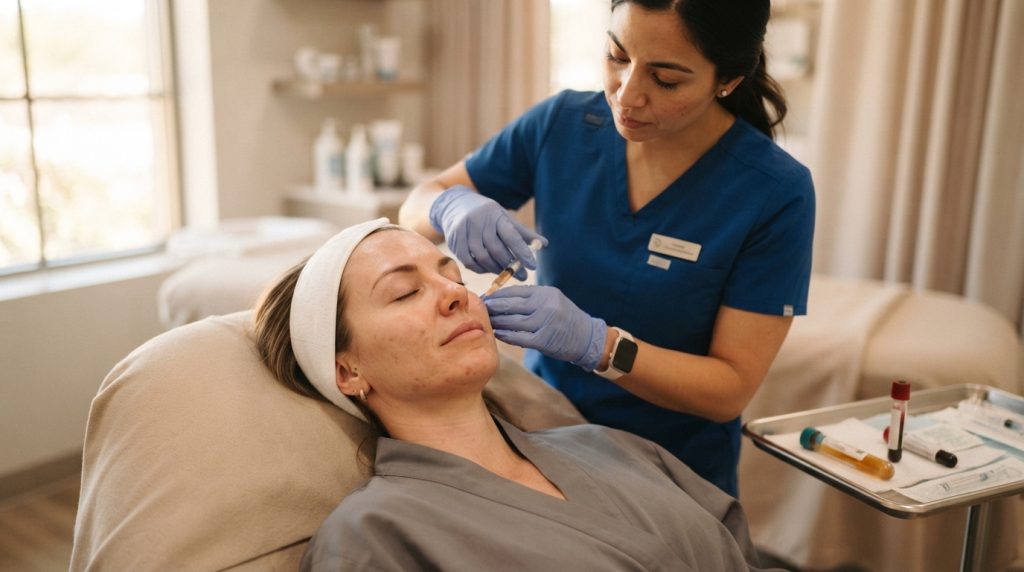
Platelet-rich plasma therapy is a minimally invasive procedure that concentrates platelets from a patient’s own blood and reintroduces them into the skin or tissue to encourage natural repair and regeneration. It has become a common option within aesthetic medicine for addressing skin texture, fine lines, and collagen loss.
PRP treatment in Downtown Naples draws on the same underlying science: blood is drawn, centrifuged, and the concentrated platelet layer is separated before being reintroduced into the skin through injection or combined with microneedling. This approach is rooted in the body’s own healing mechanisms rather than synthetic fillers or implants.
The procedure follows a consistent clinical sequence regardless of provider, built around isolating and reapplying a patient’s own platelets.
PRP is obtained by centrifuging whole blood, resulting in the separation of the blood into three distinct layers: platelet-poor plasma, platelet-rich plasma, and red blood cells. This separation step is what allows practitioners to isolate the concentrated platelet component before it is reapplied to the skin.
Clinical evidence on PRP varies by application, and results are not uniform across every use case. For skin and hair applications specifically, a 2025 systematic review and meta-analysis found that activated PRP was effective in increasing hair density and minimizing recurrence compared with placebo, while also improving clinical outcomes and patient satisfaction. The same review noted a limitation worth knowing: PRP did not significantly affect hair thickness.
Regulatory context also matters for patients evaluating PRP. PRP is not FDA approved as a drug or biologic, though the FDA regulates the centrifuges, tubes, and kits used to prepare it as medical devices, many of which are 510(k)-cleared for safety and performance. FDA clearance does not mean the agency evaluated the efficacy of PRP for every indication; it simply reviews device safety and performance. Patients considering treatment can review current device and safety standards through the FDA’s biologics and device guidance.
Patients evaluating PRP often compare it against other non-surgical treatments. The table below summarizes general differences based on how each approach works.
| Treatment | Source Material | Typical Downtime | Primary Mechanism |
| PRP Treatment | Patient’s own blood plasma | 1 to 3 days of mild redness | Growth factor release stimulates collagen |
| Dermal Fillers | Synthetic hyaluronic acid | Minimal, occasional swelling | Adds volume directly to tissue |
| Microneedling alone | None (mechanical) | 1 to 2 days of redness | Micro-injury triggers collagen response |
| Laser Resurfacing | None (light-based) | Several days to weeks | Controlled thermal injury to skin layers |
Recovery expectations for PRP in an aesthetic setting are generally short, with mild redness in the treated area resolving within a few days before patients resume normal skincare routines.
PRP is most often sought by adults looking to address early signs of collagen loss, uneven texture, or thinning hair, rather than as a treatment for active medical conditions. Because it uses the patient’s own blood, candidacy typically depends on general health screening rather than age alone. A consultation is the standard way to determine whether PRP suits an individual’s skin or hair goals, since outcomes vary based on the condition being treated and the number of sessions planned.
Based in USA, aesthetic providers serving Naples, FL offer PRP as part of a broader menu of injectable and skin rejuvenation treatments, reflecting a regional pattern among medical spas in the area that combine PRP with microneedling or facial rejuvenation protocols.
The Aesthetics Lounge and Spa Downtown Naples is one provider offering PRP alongside injectables and advanced skin treatments for patients in the surrounding service area.
Is PRP treatment painful? Most patients describe mild discomfort during the injection or microneedling portion of the procedure, often reduced with topical numbing cream applied beforehand.
How many sessions are needed to see results? Results build gradually, and many protocols involve a series of sessions spaced several weeks apart, since collagen remodeling is a gradual biological process rather than an immediate effect.
How long do PRP results last? Duration varies by individual and treatment area, with effects generally tapering over months as natural collagen turnover continues, which is why maintenance sessions are common.
Is PRP safe since it uses a patient’s own blood? Using autologous (self-derived) plasma lowers the risk of allergic reaction compared to synthetic materials, though any injectable procedure carries standard risks like bruising or minor infection at the injection site.
Current scheduling and service details for The Aesthetics Lounge and Spa Downtown Naples are published for the surrounding service area.
Keep reading
Residents searching for a medical aesthetics spa in Creekside are usually looking for one thing: a provider that...
Read article →
It often starts with a comment. A coworker asks if something is wrong during a perfectly ordinary meeting....
Read article →
Anyone searching for a refreshed, hydrated complexion without the recovery time of more aggressive treatments is likely looking...
Read article →