
Key Features to Look for in a Custom Lab Workstation Setup
Short answer: A laboratory bench is only as useful as its ability to adapt to the people and...
Read article →Home / Medical Supply Store / Article
Essentially:
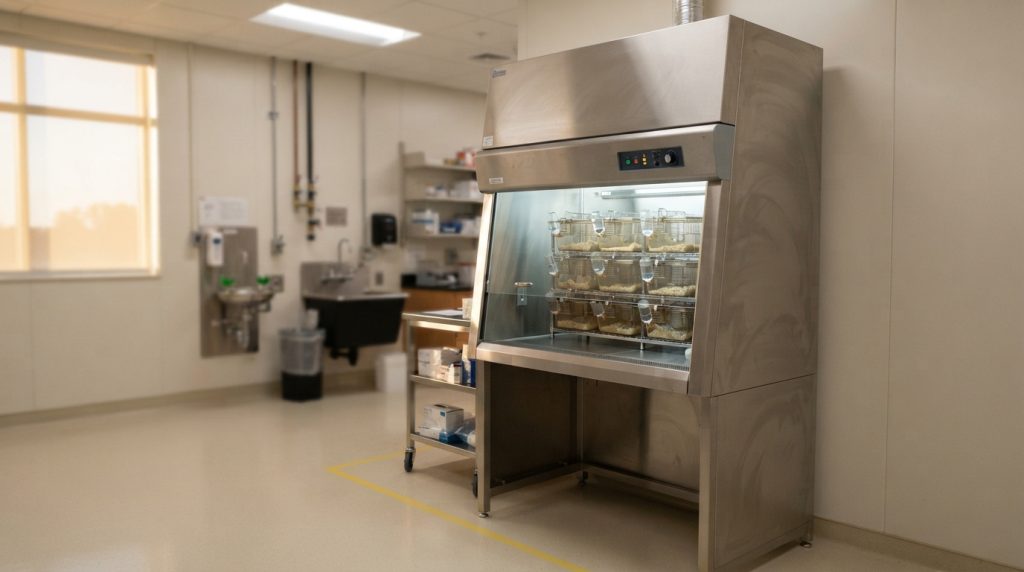
Animal handling biosafety cabinets are enclosed workstations that use HEPA-filtered airflow to contain biohazardous materials during procedures on laboratory animals, protecting both the technician performing the work and the animal inside the cabinet. These units are distinct from standard laminar flow hoods because they manage airflow in two directions at once: pulling contaminated air away from the worker while supplying clean, filtered air to the animal.
In vivarium settings, Animal Handling Biosafety Cabinets are typically required whenever procedures involve infectious agents, biohazardous specimens, or any situation where cross-contamination between animals and staff is a concern. Facilities across the USA that run BSL-2 or higher animal research programs generally treat these cabinets as a baseline safety requirement rather than an optional upgrade.
Why Airflow Design Matters for Animal Procedures
The core function of an animal handling biosafety cabinet is managing air movement so that hazardous particles never reach the operator’s breathing zone. Most vivarium-grade cabinets use a Class II Type A2 configuration, which balances recirculated and exhausted air to maintain both containment and sterility.
A product resource describing this equipment category explains that Type A2 cabinets recirculate approximately 70% of HEPA-filtered cabinet air while exhausting 30% through a dedicated exhaust HEPA filter. This split allows the cabinet to maintain a clean work zone for the animal while continuously scrubbing contaminated air before it ever reaches the room.
Federal guidance on laboratory biosafety reinforces why this distinction matters. The CDC and NIH’s joint biosafety manual notes that the CDC and NIH, a broad collaborative initiative involving scientists, laboratory directors, occupational physicians, epidemiologists, public health officials, and health and safety professionals developed the first edition of BMBL, a document that remains the operating reference for US animal biosafety levels. The CDC’s BMBL guidance outlines containment expectations for animal facilities at each biosafety level, including equipment standards that inform cabinet selection.
Core Features That Separate Animal Handling Cabinets From Standard BSCs
Standard biosafety cabinets are not always built for the physical demands of vivarium work. Cage changing, feeding, and specimen transfer require different ergonomics than bench-top microbiology work.
Equipment built specifically for this use tends to include:
A manufacturer resource describing this category notes that animal research facilities require five core types of airflow equipment: Individually Ventilated Cages with HEPA-filtered supply and exhaust, Class II Type A2 Biosafety Cabinets for biohazardous animal handling, Cage Change and Animal Transfer Stations for allergen control, Animal Refuse Workstations for cage dumping and waste management, and HVAC systems that maintain species-specific temperature, humidity, and pressure cascades. Biosafety cabinets sit at the center of that list because they are the point where direct animal contact and biohazard exposure intersect.
Choosing the Right Configuration for a Vivarium
Cabinet selection usually comes down to the procedures a facility runs most often. A lab doing routine, non-infectious cage changes has different needs than one working with infected rodent models under BSL-2 containment.
| Equipment Type | Primary Purpose | Typical Use Case |
|---|---|---|
| Animal Transfer Station | Allergen protection for handler | Routine cage changes, healthy animals |
| Class II Type A2 Animal Handling BSC | Full biocontainment for animal, handler, environment | Infected animals, biological agents, BSL-2 procedures |
| Pass-Through BSC | Safe animal transfer between rooms | Moving animals across containment zones |
| Animal Refuse Workstation | Contained cage/bedding disposal | Waste handling after procedures |
One manufacturer resource on vivarium airflow equipment, NuAire, Inc, describes the distinction this way: Class II Biosafety Cabinets are mandatory when working with biohazardous agents or when sterile conditions are required, and for animal facilities, the Class II Type A2 configuration is the preferred choice. Facilities evaluating equipment generally match the cabinet class to their animal biosafety level rather than defaulting to the largest or most feature-dense unit available.
Frequently Asked Questions
Are animal handling biosafety cabinets required for all vivarium work? Not always. Facilities doing routine cage changes on healthy, non-infected animals often use allergen-focused transfer stations instead, reserving full biosafety cabinets for procedures involving infectious agents or BSL-2 animal work.
What makes Type A2 the common choice for animal procedures? Type A2 cabinets balance recirculated and HEPA-exhausted air, which protects the worker from aerosols while still maintaining a clean environment around the animal during handling.
Do these cabinets need regular certification? Yes. Biosafety cabinets used in US research facilities are typically certified on a scheduled basis to confirm HEPA filter integrity and correct airflow balance, consistent with national biosafety guidance.
Can one cabinet serve multiple animal species or procedures? Some configurations are adaptable, but cage size, access opening width, and airflow volume should match the specific species and procedure type rather than being assumed universal.
Selecting the correct animal handling biosafety cabinet depends on the biosafety level, species, and procedure volume specific to a given vivarium. Facility managers evaluating new or replacement equipment can review current cabinet specifications and containment ratings before making a purchasing decision.
Keep reading
Short answer: A laboratory bench is only as useful as its ability to adapt to the people and...
Read article →
Dental professionals are deeply committed to patient safety and comfort, but allergic reactions in the dental office can...
Read article →
Needle-related injuries are a major concern in medical settings, posing risks to both healthcare workers and patients. A...
Read article →