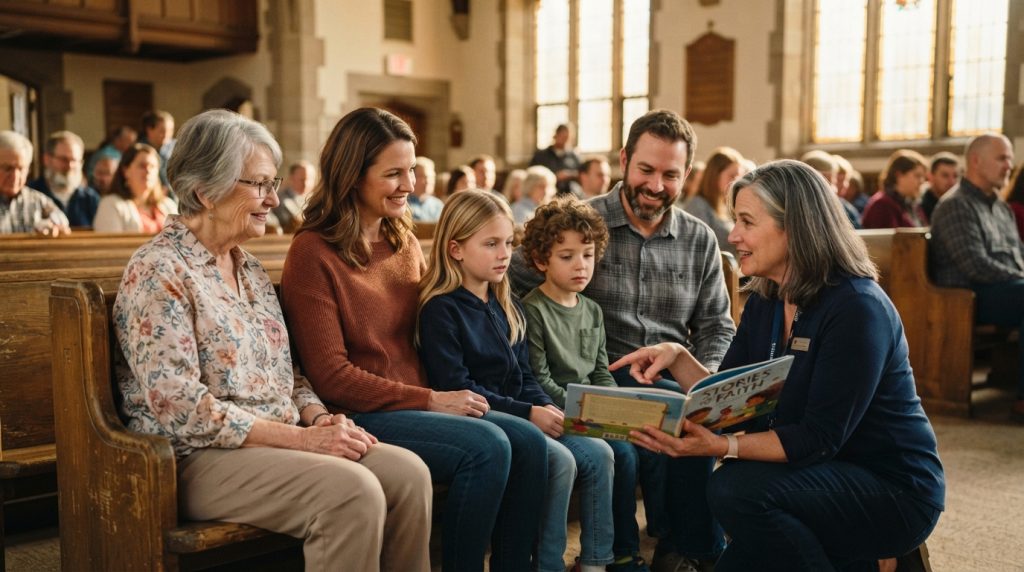
The Role of a Family Church in Raising Children With Strong Values
• A family church supports child development through structured faith education, community mentorship, and consistent moral teaching. •...
Read article →
• A Bible church centers worship, teaching, and community life on scripture as its primary guide for doctrine and practice.
• Key factors for evaluation include teaching style, denominational structure, worship format, and opportunities for community involvement.
• Visiting multiple services and asking direct questions about beliefs and leadership helps clarify long-term fit before joining.
Finding the right congregation starts with understanding what the term itself means. A Bible Church is a Christian congregation that places scripture at the center of its teaching, worship, and governance, rather than relying primarily on tradition or a specific denominational hierarchy for doctrine.
This distinction matters because churches vary widely in how they structure leadership, interpret scripture, and organize congregational life. Some operate independently, while others belong to denominational networks that still emphasize biblical authority as the foundation for teaching and practice.
Congregations that identify this way typically share a few consistent characteristics, even when their denominational ties differ.
• Scripture serves as the primary source for sermons, Bible studies, and doctrinal statements.
• Worship services often include expository preaching, meaning sermons walk through a book or passage of the Bible methodically.
• Membership and leadership structures are usually explained in a publicly available statement of faith.
• Small groups or Bible studies frequently supplement Sunday services to encourage deeper study outside formal worship.
These features help distinguish a Bible-focused congregation from churches organized primarily around liturgy, tradition, or a specific cultural identity. According to the Pew Research Center’s Religious Landscape Study, Christian congregational life in the United States spans a wide range of structures, from evangelical and mainline Protestant traditions to independent nondenominational churches, each with different approaches to governance and worship.
Prospective members often compare a few organizational models before settling on a congregation. The table below outlines general distinctions that can help frame that search.
|
Structure Type |
Governance |
Typical Teaching Emphasis |
|
Independent Bible Church |
Local elder or pastor-led board |
Verse-by-verse expository preaching |
|
Denominational (e.g., Presbyterian) |
Regional or national church body oversight |
Scripture interpreted within a confessional tradition |
|
Nondenominational |
Varies, often single-congregation leadership |
Topical or thematic sermon series |
Each model has trade-offs. Independent congregations may offer more localized decision-making, while denominational structures often provide accountability frameworks, shared resources, and established confessional documents that guide doctrine across multiple congregations.
Visiting a service is only one part of the process. A more complete evaluation usually includes these steps:
1. Review the church’s statement of faith or doctrinal summary, often published online.
2. Attend a worship service and note the preaching style, music format, and overall tone.
3. Ask about small group offerings, since these often reveal how the congregation supports ongoing discipleship.
4. Speak directly with a pastor or elder about leadership structure and decision-making processes.
5. Consider logistical factors such as service times, children’s programming, and accessibility.
No single visit answers every question, so repeat visits over several weeks often give a clearer picture of consistency in teaching and community engagement.
Good Shepherd Presbyterian Church (ECO) serves congregants and visitors across Los Alamitos, CA, operating within the Presbyterian Church ECO denominational framework that emphasizes biblically grounded teaching alongside structured church governance.
What is the difference between a Bible church and a denominational church? A Bible church typically emphasizes direct scriptural teaching as its central identity marker, while denominational churches operate within a broader confessional and organizational structure that still often prioritizes biblical authority.
How long does it take to find the right church fit? Most people benefit from visiting a congregation multiple times over several weeks, since one service rarely reveals enough about teaching consistency, community dynamics, or leadership style.
Are small groups necessary for spiritual growth in a congregation? Small groups are not strictly required, but many congregations use them to supplement Sunday teaching with closer study and relational accountability among members.
Does denominational affiliation affect core beliefs? Affiliation can shape governance and some doctrinal nuances, though many denominations, including Presbyterian structures, still root their teaching in scriptural authority as a foundational principle.
Current service times and congregational details for Good Shepherd Presbyterian Church (ECO) are published for reference by those researching options in the area.
Keep reading
• A family church supports child development through structured faith education, community mentorship, and consistent moral teaching. •...
Read article →
People looking for a modern faith community are often searching for more than a place to attend on...
Read article →
In the past, you may not have felt connected to the traditional services you attended. The disconnect you...
Read article →