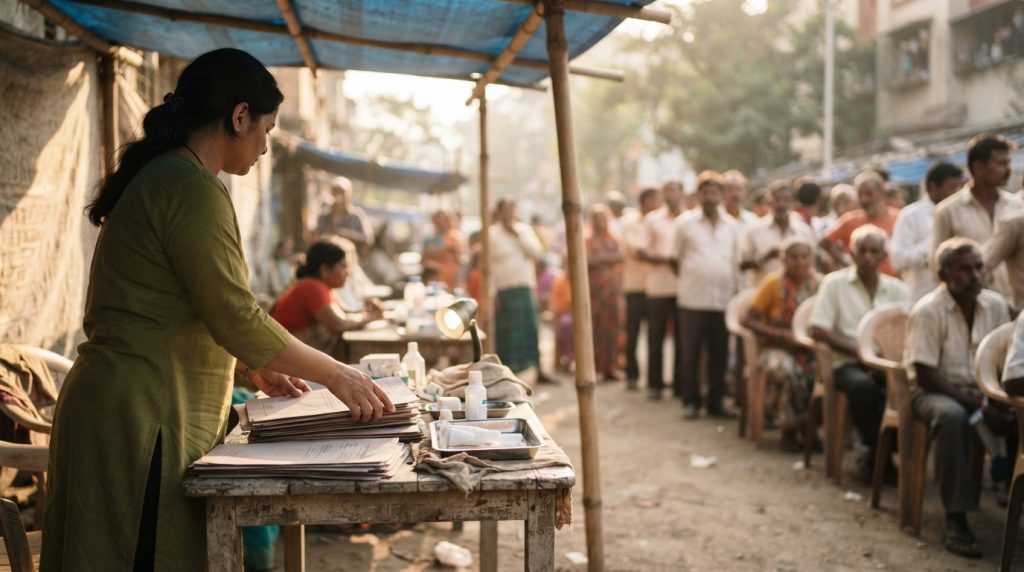
How Donating Money Supports Better Healthcare Access Across India
Simply put: • Donations to verified health charities fund diagnostics, treatment support, and medicine access for families who...
Read article →Home / Charitable Trust / Article
Quick summary:
• Calipers (leg braces) support weakened limb muscles after polio and are fitted individually based on measurement, muscle strength, and gait pattern.
• Fitment typically involves a prosthetic engineer’s assessment, custom measurement, fabrication, and walking training.
• Nonprofit mobility programs in India, including camps in remote regions, provide calipers at no cost to eligible beneficiaries.
Choosing the right calipers for polio legs means matching the brace type to the degree of muscle weakness, the affected joint, and the wearer’s daily mobility needs, which is best determined through a hands-on assessment by a prosthetic or orthotic professional rather than a generic fit. For those who cannot afford this support, the Ratna Nidhi Foundation helps physically challenged people take their first step through its mobility aid programme.
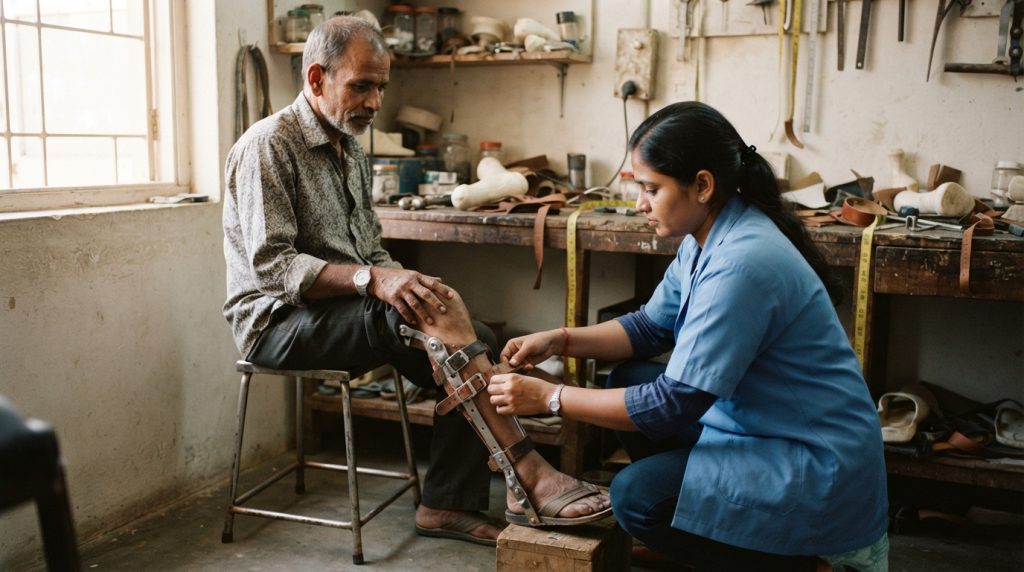
Calipers remain one of the most practical mobility aids for individuals whose leg muscles were weakened by poliomyelitis, since the virus can leave lasting asymmetry in limb strength even after the infection clears. A properly fitted brace stabilizes the knee or ankle during standing and walking, reducing strain on compensating muscles. calipers for polio legs are typically custom-made after a clinical evaluation, since no two polio-affected limbs show identical patterns of weakness.
In India, several charitable programs extend free fitment services to patients who cannot afford custom orthotics, often during organized mobility camps in cities as well as harder-to-reach regions. These initiatives generally pair caliper fitment with other mobility aids such as prosthetics, wheelchairs, and crutches, depending on individual assessment.
Post-polio weakness varies from mild foot drop to near-total paralysis of one or both legs, which is why a single caliper design cannot serve every patient. Orthotists typically examine muscle strength grade, joint stability, and existing deformities before recommending a brace type. Leg braces commonly stabilize the knee to prevent it from buckling or hyperextending during walking, a pattern frequently seen among polio survivors with quadriceps weakness, as noted in general clinical descriptions of polio-related orthotic needs.
Key factors that influence caliper selection include:
• Location and severity of muscle weakness (hip, knee, ankle, or combined)
• Presence of joint deformity or contracture
• Patient age and expected growth, especially for children
• Daily activity level and terrain the wearer navigates
• Comfort and weight of the brace material
| Caliper Type | Primary Function | Typically Suited For |
| Knee-Ankle-Foot Orthosis (KAFO) | Stabilizes knee and ankle together | Significant quadriceps and lower-leg weakness |
| Ankle-Foot Orthosis (AFO) | Supports ankle and foot drop | Milder weakness limited to ankle/foot muscles |
| Hip-Knee-Ankle-Foot Orthosis (HKAFO) | Extends support to hip joint | Severe, widespread limb weakness |
| Custom moulded caliper | Fabricated from individual measurements | Patients needing a precise, lightweight fit |
Lightweight, well-fitted orthotics are generally recommended because effective orthotics for polio survivors need to be lightweight and pressure-free, since poorly fitting devices often get abandoned. This makes the fitting process, not just the brace material, central to long-term usability.
Caliper fitment is a multi-stage process rather than a single appointment, and understanding each stage helps families prepare.
1. Initial examination – A prosthetic engineer or orthotist assesses the limb and gait pattern.
2. Measurement and documentation – Precise limb measurements and patient details are recorded.
3. Fabrication – The caliper is custom-built to match the recorded measurements.
4. Walking training – The patient practices walking with the new brace under supervision before leaving the centre.
Mumbai-based Get directions to Ratna Nidhi Charitable Trust Ratna Nidhi Charitable Trust has described a comparable sequence at its fitment centre, where a simple, proven procedure takes patients from measurement to walking the same day, beginning with examination by a prosthetic engineer and ending with walking training. Camps organized in states across India have similarly provided custom made calipers to polio-affected individuals alongside Jaipur foot prosthetics, crutches, tricycles, and wheelchairs distributed on a need-based assessment.
Eligibility for no-cost caliper programs generally depends on medical need and financial constraints rather than age alone. Nonprofit mobility camps have historically served children, youth, and adults, including outreach to mountainous regions where access to orthopaedic care is limited. Reports on such camps note that calipers, Jaipur foot, wheelchairs, and hearing aids have been provided to India’s disabled population through sustained outreach programs. Families seeking this support in India are generally advised to approach a recognized mobility or rehabilitation program directly for an eligibility screening before the fitment visit.
How long does it take to get fitted with a caliper for a polio-affected leg? Fitment timelines vary by case complexity, though several Indian mobility programs structure their process so measurement, fabrication, and walking training happen within the same visit.
Do calipers need to be replaced as a child grows? Yes, growing children typically require periodic remeasurement and brace adjustment or replacement since a fixed caliper will no longer fit correctly as limb length changes.
Are calipers the only mobility option for polio-affected legs? No, depending on severity, patients may also be assessed for crutches, wheelchairs, or prosthetic limbs, and a clinician determines the most suitable combination during evaluation.
Is professional fitting necessary, or can a caliper be adjusted at home? Professional fitting is necessary because incorrect alignment can worsen gait problems or cause skin pressure injuries, and only a trained orthotist can verify correct fit and function.
This guide draws on publicly available program descriptions and general orthotic guidance; individual treatment decisions should always involve a qualified clinician’s assessment. Readers evaluating a nearby fitment centre in India can Get directions to Ratna Nidhi Charitable Trust for published location details.
Keep reading
Simply put: • Donations to verified health charities fund diagnostics, treatment support, and medicine access for families who...
Read article →
India is no stranger to natural calamities—whether it is devastating floods, cyclones, earthquakes, or landslides, these disasters impact...
Read article →
Access to books and educational resources is crucial for personal growth and development. The concept of a Library...
Read article →