What Homeowners Should Know About Seamless Gutters
Summary first: Seamless gutters are formed from a continuous length of metal cut to match a home’s specific...
Read article →
Briefly:
• Seamless gutters are formed on-site in one continuous aluminum run, reducing the joints where leaks typically start.
• Properly sized 6-inch or 7-inch systems handle Tampa, FL’s heavy seasonal rainfall better than standard sectional gutters.
• Correct installation protects fascia boards, foundations, and landscaping from water erosion and structural decay.
Seamless gutter installation reduces water damage by channeling roof runoff through a single, custom-fabricated trough with no horizontal seams, which lowers the risk of leaks at the joints that typically fail first in sectional systems. This matters most in regions with intense, short-duration storms, where even small leak points can overwhelm a drainage system during peak flow.
A Seamless Gutter Installation Tampa FL is formed from a continuous roll of aluminum, cut to match the exact length of a roofline rather than assembled from pre-cut sections joined by seams. This approach is common across the Tampa Bay region, where contractors note that seamless systems are formed and installed on site, cut to the precise length of the roof edge. Fewer joints generally translate to fewer potential leak points along the gutter run.
Tampa’s rainfall pattern places unusual demands on residential drainage systems. The region receives substantial precipitation concentrated in a few months each year.
• Tampa’s average annual rainfall is approximately 49.5 inches , based on NOAA 1991-2020 Climate Normals .
• August is typically the wettest month, with roughly 9 inches of rainfall on average.
• Summer storms between June and September can deliver several inches of rain within a short window, straining undersized gutters.
Industry sources serving the Tampa area commonly note that most homes require 6-inch gutters due to large roof areas and heavy tropical rainfall, with gutter capacity calculated based on roof square footage, pitch, and local rainfall intensity. Homes with steep rooflines, tile roofing, or large surface areas may need 7-inch profiles to handle higher-volume runoff without overflow.
Seamless gutter systems differ from pre-formed sectional products mainly in how and where they are manufactured. The process generally follows a consistent sequence regardless of installer.
1. Site evaluation – Measuring the roofline, assessing pitch, and identifying water collection points.
2. Material and profile selection – Choosing between 5-inch, 6-inch, or 7-inch aluminum profiles based on roof area and expected rainfall volume.
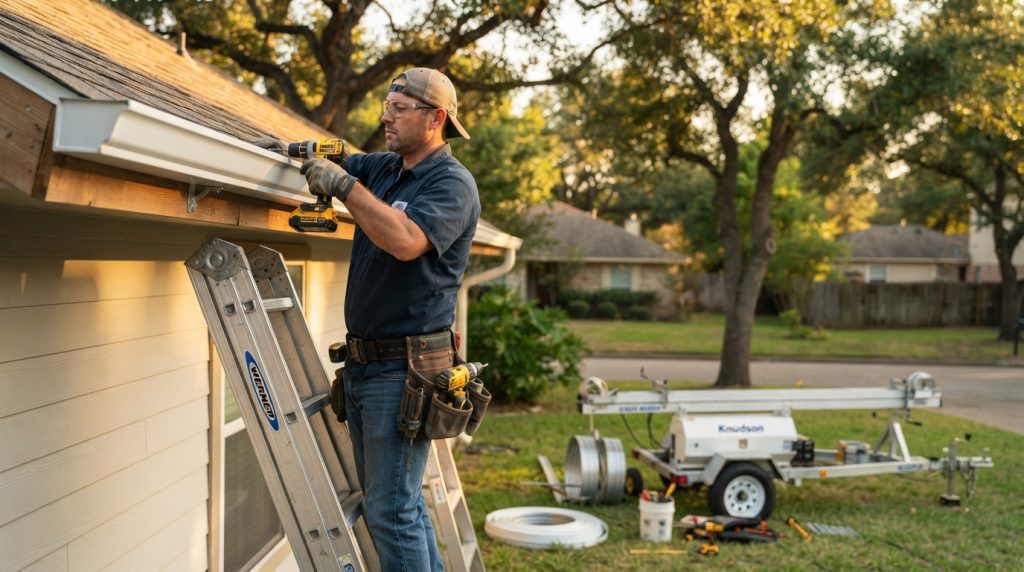
3. On-site fabrication – Forming each gutter run from a continuous aluminum coil using portable roll-forming equipment so the piece matches the roofline without horizontal seams.
4. Mounting and downspout placement – Securing the gutter with fasteners and positioning downspouts to direct water away from the foundation.
Most residential installations of this type are completed within a single day, though larger homes or properties with complex rooflines may require additional time for fabrication and fitting.
| Factor | Seamless Gutters | Sectional Gutters |
| Joints per run | None along straight sections | Joints every 10 feet |
| Leak risk | Lower, fewer seam failures | Higher, seams can separate over time |
| Fabrication | Formed on-site to exact roof length | Pre-cut lengths joined on-site |
| Fit | Custom to each roofline | Standardized lengths |
Reduced seam count is the primary reason seamless systems are associated with fewer leak points and less frequent maintenance in markets with heavy rainfall, including the Tampa Bay area.
Water that is not properly directed away from a structure can affect several components over time. Recognizing these risks clarifies why correct sizing and installation quality matter beyond simple curb appeal.
• Fascia board deterioration from prolonged water contact at the roofline.
• Foundation erosion when overflow pools near the base of a structure.
• Landscaping damage from concentrated runoff in planting beds.
• Interior moisture intrusion in cases of severe or sustained overflow.
Based in USA, Gutter Doctor Inc. serves customers across Tampa, FL, and installation practices described above reflect general industry standards observed across gutter contractors operating in that service area.
How long does seamless gutter installation typically take? Most residential projects are completed in a single day, though homes with complex rooflines or larger square footage may require extra time for on-site fabrication.
What gutter size is recommended for Tampa homes? Six-inch profiles are common for standard shingle roofs, while 7-inch profiles are often recommended for steep pitches, tile roofing, or larger roof areas that generate higher runoff volumes.
Do seamless gutters require a permit in Tampa, FL? Permit requirements can vary by municipality and project scope, so homeowners should confirm specific requirements with local building authorities before installation begins.
How does material choice affect gutter performance? Aluminum is widely used for residential seamless gutters because it resists rust, holds paint finishes well, and is lightweight enough for on-site forming, though copper and galvanized steel are also used in some installations.
Additional background on seamless gutter installation practices and material options is available through Gutter Doctor Inc.’s published service information.
Keep reading
Summary first: Seamless gutters are formed from a continuous length of metal cut to match a home’s specific...
Read article →
Water damage is one of the most common and costly issues homeowners face, often resulting from something as...
Read article →
When searching for a trustworthy partner to address home drainage concerns, many homeowners turn to Gutter Company Branford,...
Read article →