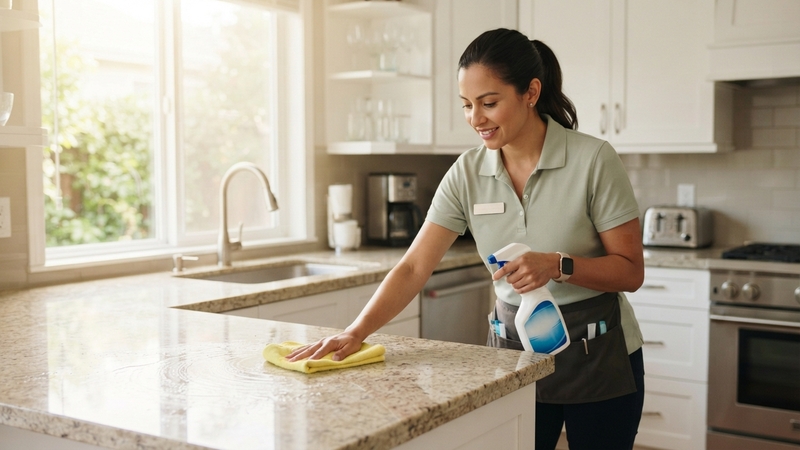
A Complete Guide to Understanding House Cleaning Services
Takeaway: • House cleaning services typically cover recurring maintenance, deep cleaning, and move-in/move-out cleaning for homes of varying...
Read article →Home / Home Improvement / Article

In brief:
A reliable home cleaning routine depends on separating tasks by frequency, setting realistic timeframes, and following a consistent order so dirt and clutter don’t accumulate between sessions. Households that break cleaning into daily, weekly, and periodic deep-cleaning tiers tend to maintain cleaner homes with less overall effort than those relying on sporadic marathon cleaning days.
For residents weighing whether to handle cleaning independently or bring in outside help, understanding what a Hall-Mark Premier House Cleaning Service actually covers can clarify where a routine ends and professional support begins. Recurring cleaning visits, available on weekly, biweekly, or monthly schedules, handle the repetitive maintenance tasks that otherwise pile up on a household’s to-do list.
Breaking cleaning into tiers prevents any single task list from becoming overwhelming.
This tiered approach matches how dirt and allergens actually accumulate. Light surface debris builds daily, while dust, grime, and bacteria require weekly attention, and deeper buildup in less-visible areas needs periodic deep cleaning.
Indoor air and surface quality depend heavily on how often a home is cleaned, not just how thoroughly it is cleaned once. The EPA’s indoor air quality guidance identifies source control, including regular cleaning and dust reduction, as the most effective way to limit household pollutants before considering ventilation or air filtration upgrades.
For homes in Loveland, OH, seasonal shifts add a few more considerations. Pollen season in spring, higher humidity in summer, and closed-window months in winter each change which surfaces and rooms need more frequent attention. A routine that adjusts slightly by season, rather than staying fixed year-round, tends to keep allergen and dust levels more consistent.
Even a well-structured routine can fall short when schedules get busy, a household grows, or certain tasks take longer than daily life allows. Recurring cleaning services fill this gap by handling repetitive maintenance work on a set schedule, so households don’t have to fit every task into their own calendar.
The table below compares common service types by what they typically cover.
| Service Type | Typical Frequency | Best Suited For |
| Recurring cleaning | Weekly, biweekly, or monthly | Ongoing maintenance of a regularly used home |
| Deep cleaning | One-time or periodic | Resetting a home before starting a recurring schedule |
| Move-in/move-out cleaning | Single visit | Preparing a property for sale, rental, or relocation |
Based in Cincinnati, provides recurring and deep-cleaning support to households throughout Loveland, OH, and several nearby communities. The company’s cleaning professionals are background-checked, and its description notes that it is a locally owned, woman-owned residential and commercial cleaning company based in Cincinnati, Ohio, offering recurring house cleaning on weekly, biweekly, and monthly schedules, deep cleaning, and move-in and move-out cleaning.
A cleaning routine holds up over time when it accounts for household size, pets, allergy sensitivities, and the realistic amount of time available each week. Starting with a short daily list, adding a manageable weekly block, and reserving deeper tasks for monthly or seasonal sessions keeps the workload predictable rather than reactive.
Adjusting the routine after a few weeks, based on which areas get dirty fastest, helps fine-tune frequency without overcomplicating the schedule.
How often should a home be deep cleaned? Most households benefit from a deep clean every three to six months, depending on household size, pets, and allergy sensitivities, with lighter weekly cleaning handling routine maintenance in between.
What is the difference between standard and deep cleaning? Standard cleaning covers surface-level upkeep like dusting, vacuuming, and wiping down bathrooms, while deep cleaning addresses less-visible buildup such as baseboards, grout, and appliance interiors.
Can a cleaning routine reduce indoor allergens? Regular dusting, vacuuming, and surface cleaning are source-control measures that can reduce indoor allergens and dust buildup over time.
Is professional cleaning worth it for busy households? Recurring professional cleaning can fill gaps in a household routine, particularly for families or individuals with limited time for weekly maintenance tasks.
Household cleaning schedules vary by home size and lifestyle, and readers comparing local options can contact Hall-Mark Premier House Cleaning Service for published service details.
Keep reading
Takeaway: • House cleaning services typically cover recurring maintenance, deep cleaning, and move-in/move-out cleaning for homes of varying...
Read article →
Bottom line: • Custom shutters are measured and built for exact window dimensions, which improves fit, insulation, and...
Read article →
Summary: • Routine cleaning reduces household dust, allergens, and surface germs more effectively than occasional deep cleans alone....
Read article →